

Editor's Choice


Quectel’s RG255C-NA and RM255C-GL accelerate 5G RedCap adoption

28 February 2026 Editor's Choice Telecoms, Datacoms, Wireless, IoT

The evolution of 5G is entering a new phase. While early deployments focused on enhanced mobile broadband (eMBB) for high-speed consumer applications, the next wave of growth is being driven by industrial IoT, smart infrastructure and connected devices that require balanced performance, efficiency, and scalability. At the centre of this shift is 5G Reduced Capability (RedCap) technology, defined under 3GPP Release 17, which is designed to bridge the gap between high-end 5G modules and lower-speed LTE solutions.
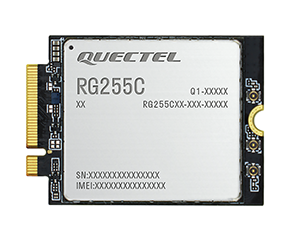

Figure 1. RG255C-NA.

Quectel’s RG255C-NA and RM255C-GL modules represent a strategic move into this fast-growing segment, delivering Sub-6 GHz 5G connectivity optimised for mid-tier IoT applications. By combining reliable throughput, reduced complexity and improved power efficiency, these modules provide an ideal solution for industrial and commercial deployments transitioning to 5G.

Understanding the role of 5G RedCap

RedCap technology is engineered for devices that do not require the extremely high data rates or antenna complexity of traditional 5G eMBB modules, but still benefit from 5G’s lower latency, network slicing, and long-term scalability. Typical applications include smart meters, industrial automation systems, telematics units, asset trackers, gateways, and fixed wireless access (FWA) devices.

With theoretical peak data rates of up to 223 Mbps downlink and 123 Mbps uplink, the RG255C-NA and RM255C-GL deliver more than sufficient bandwidth for these use cases. At the same time, RedCap reduces hardware complexity by lowering bandwidth requirements and RF design overhead, resulting in more cost-effective and power-efficient deployments.

Both modules support 5G Standalone networks and maintain backward compatibility with LTE, ensuring seamless operation in areas where 5G coverage is still expanding.

Two form factors for diverse integration needs

Although the RG255C-NA and RM255C-GL share a common technology platform, they are designed for different integration strategies.
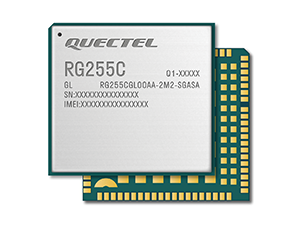

Figure 2. RM255C-GL in M.2 form factor.

The RG255C-NA comes in a compact LGA package measuring 29,0 x 32,0 x 2,4 mm, making it well suited for space-constrained embedded systems. This variant is tailored specifically for North American frequency bands, enabling OEMs targeting the US and Canadian markets to streamline certification and deployment.

The RM255C-GL, in contrast, adopts a widely used M.2 form factor (30,0 x 42,0 x 2,3 mm). This design makes it particularly attractive for industrial PCs, routers, and gateways equipped with M.2 slots. One of its key advantages is pin-to-pin compatibility with several existing Quectel LTE and 5G modules, allowing manufacturers to upgrade product lines to 5G RedCap with minimal hardware redesign.

Industrial-grade performance

Designed with demanding environments in mind, both modules support an operating temperature range of -30°C to 75°C, with extended temperature options available for harsher industrial settings. This makes them suitable for outdoor installations, utility infrastructure, and transportation systems.

The modules incorporate advanced 5G features including:

• Ultra-Reliable Low Latency Communication for time-sensitive applications.

• Network slicing, enabling dedicated logical networks for specific services.

• 5G LAN support, allowing 5G to function as a virtual local area network.

• Device Firmware Over-the-Air for remote updates and lifecycle management.

Optional multi-constellation GNSS support – including GPS, GLONASS, Galileo, BeiDou, QZSS and NavIC – adds precise positioning capability, expanding their suitability for fleet management, logistics, and tracking solutions.

The RG255C-NA and RM255C-GL provide a comprehensive range of interfaces, including USB 2.0, PCIe 2.0, UART, (U)SIM, SPI, and PCM. Driver support is available for Windows, Linux, and Android platforms, complemented by Quectel’s enhanced AT command set. This ensures flexibility across development environments and simplifies system design.

The RG255C-NA and RM255C-GL provide OEMs with flexible hardware options and a future-proof migration path toward 5G. Whether integrated directly onto embedded boards via LGA or deployed in modular gateway designs via M.2, these modules offer a scalable, standards-compliant solution aligned with the next generation of connected infrastructure.


Credit(s)


Share this article:
Share via emailShare via LinkedInPrint this page

Further reading:

Engineering in a world that cannot assume connectivity
Technews Publishing Editor's Choice News
Across industrial automation, networking, and defence systems, engineers are rediscovering the importance of resilience and autonomy in an increasingly connected world.

Read more...
NVDC power-path control to 1– 6 cell battery systems
iCorp Technologies Power Electronics / Power Management
SG Micro’s SGM41581 is an I2C-controlled narrow voltage direct charging buck boost charge controller designed to simplify robust power delivery in systems that must seamlessly operate from an adapter input or a battery pack.

Read more...
iCorp brings BeeLee’s compact switch and sensor components to local designers
iCorp Technologies Switches, Relays & Keypads
BeeLee’s product catalogue includes (among others) vibration sensors, tilt ball switches, reed switches, hall sensors, optocoupler (photo interrupter) devices, and liquid level switches.

Read more...
Designing IoT devices for deterministic LPWAN environments
Editor's Choice Telecoms, Datacoms, Wireless, IoT
Built on Ultra Narrow Band communication technology, the Sigfox network focuses on low power, wide area M2M connectivity rather than maximising data throughput.

Read more...
Wi-Fi 7 tri-band connectivity module
iCorp Technologies Telecoms, Datacoms, Wireless, IoT
Quectel has introduced the FCE870Q, a compact short range wireless connectivity module designed for next generation IoT devices that require high throughput, low latency, and reliable operation in dense wireless environments.

Read more...
Driving excellence in electronics manufacturing
Jemstech Editor's Choice Manufacturing / Production Technology, Hardware & Services
Jemstech’s reputation for disciplined execution and client-focused service has earned it strong loyalty from companies operating in demanding industries.

Read more...
Lower-power Thread and BLE connectivity
iCorp Technologies DSP, Micros & Memory
Espressif has released the ESP32-H21, a low-power wireless SoC aimed at Thread, Matter, Zigbee, and Bluetooth LE device designs.

Read more...
In sync with the line
Testerion Editor's Choice Manufacturing / Production Technology, Hardware & Services
In modern SMT lines, stencil printing must meet two requirements at the same time: it has to ensure a reproducible solder paste volume, while adhering to the specified line cycle time.

Read more...
Enabling the next generation of high-performance wireless designs
iCorp Technologies Telecoms, Datacoms, Wireless, IoT
Espressif Systems has expanded its wireless connectivity portfolio with the introduction of the ESP32-E22, a high-performance connectivity co-processor designed for next generation embedded and IoT systems.

Read more...
Resilient navigation in warfare: The role of non-GNSS
Etion Create Editor's Choice
Alternative navigation methods are essential for maintaining operational capability when satellite signals are unreliable or unavailable.

Read more...


While every effort has been made to ensure the accuracy of the information contained herein, the publisher and its agents cannot be held responsible for any errors contained, or any loss incurred as a result. Articles published do not necessarily reflect the views of the publishers. The editor reserves the right to alter or cut copy. Articles submitted are deemed to have been cleared for publication. Advertisements and company contact details are published as provided by the advertiser. Technews Publishing (Pty) Ltd cannot be held responsible for the accuracy or veracity of supplied material.


© Technews Publishing (Pty) Ltd | All Rights Reserved