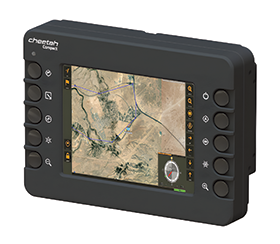
Etion Create’s CheetahNAV Compact is a versatile tactical navigation system designed for security services, emergency services, and light all-terrain vehicles (ATVs) using user-controlled offline navigation maps.
The system was recently shown at the IDEX 2025 exhibition in the United Arab Emirates.
The compact navigation system is a field proven high precision GNSS-aided Inertial Navigation System (INS) which utilises:
• A tactical grade Inertial Measurement Unit (IMU) based on MEMS sensors.
• An embedded, multi constellation and multi frequency GNSS receiver.
• An advanced Kalman Filter-based algorithm providing very accurate position information, navigation, time, velocity, and orientation in both GNSS-enabled and GNSS-denied environments.
The CheetahNAV Compact utilises real-time moving map technology that provides the driver and crew members with accurate situational awareness information that is continuously updated. The system has a user-friendly graphical navigation capability, combining inertial and satellite position information for accurately navigating between pre-set waypoints towards the final destination. Its integrated inertial measurement unit (IMU) ensures jamming free operation and continued operation during emergency conditions where normal communication networks are compromised, providing a dead reckoning accuracy within 0,2% of distance travelled. This translates to an error within 200 metres over a distance of 100 kilometres in a GNSS-denied environment. With GNSS active, horizontal position accuracy is 1,8 m.
The system features a resistive touch, sunlight-readable 8,4-inch TFT with a resolution of 1024 x 768. The integrated GNSS module is capable of receiving up to 184 channels from multiple constellations (GPS L1/L2, GLONASS L1, Galileo E1/E5, BeiDou B1/B2) with an update rate of 10 Hz.
Interfaces on the system include 100/1000 Base-T Ethernet, RS422, USB, CAN, and for the IMU/INS. A port for an optional external GNSS antenna is also provided. The unit has a MIL-STD810G rating for vibration, shock, humidity, and sand/dust, and has an operating temperature range of -20 to 71°C.
Wireless connectivity expanded iCorp Technologies
Telecoms, Datacoms, Wireless, IoT
Espressif Systems has introduced two new members of its ESP32 wireless SoC family: the ESP32-E22, the company’s first Wi-Fi 6E connectivity chip, and the ESP32-H21, an ultra-low-power Bluetooth LE microcontroller aimed at coin-cell and battery-powered devices.
Read more...Integrated X-band radar front-end module RF Design
Telecoms, Datacoms, Wireless, IoT
Qorvo has introduced an X-band radar front-end solution that enables defence system designers to achieve higher performance without increasing size, weight or prime power.
Read more...Introducing Aurata CST Electronics
Telecoms, Datacoms, Wireless, IoT
Antenova has launched Aurata SR4L112: a compact, high efficiency embedded 4G/LTE antenna engineered for long, narrow PCB designs.
Read more...Multi-constellation GNSS module in a legacy-compatible footprint Altron Arrow
Telecoms, Datacoms, Wireless, IoT
Telit Cinterion has announced the SE869eK2L, a single-frequency L1 GNSS module designed to help device manufacturers upgrade legacy positioning designs with improved performance and cost efficiency, while preserving design continuity.
Read more...Quectel expands 5G portfolio iCorp Technologies
Telecoms, Datacoms, Wireless, IoT
Quectel expands 5G portfolio with new Qualcomm- and UNISOC-based modules.
Read more...Compact RTK design: More than just the receiver iCorp Technologies
Editor's Choice Telecoms, Datacoms, Wireless, IoT
In practice, engineers building compact RTK products keep discovering the same thing: the hardest component in the system is no longer the receiver. It is the antenna.
Read more...Microchip advances Space-Grade timing performance ASIC Design Services
Telecoms, Datacoms, Wireless, IoT
Microchip Technology has expanded its atomic clock portfolio with the radiation-tolerant Space CSAC-SA65, a Chip Scale Atomic Clock designed to deliver precise timing for space systems.
Read more...Channel emulator for 6 G and Wi-Fi 7/8 Concilium Technologies
Telecoms, Datacoms, Wireless, IoT
With 400 MHz instantaneous bandwidth and support for carrier frequencies up to 23,6 GHz, Vertex 6.0 is the industry’s first channel emulator designed for next generation 6 G and Wi-Fi 7/8 testing.
Read more...Secure, low-power Bluetooth LE SoC NuVision Electronics
Telecoms, Datacoms, Wireless, IoT
Silicon Labs unveils BG2B, its lowest-power Bluetooth LE SoC with industry-leading power efficiency, security, and integration.
While every effort has been made to ensure the accuracy of the information contained herein, the publisher and its agents cannot be held responsible for any errors contained, or any loss incurred as a result. Articles published do not necessarily reflect the views of the publishers. The editor reserves the right to alter or cut copy. Articles submitted are deemed to have been cleared for publication. Advertisements and company contact details are published as provided by the advertiser. Technews Publishing (Pty) Ltd cannot be held responsible for the accuracy or veracity of supplied material.









 printer friendly version