


DDR5 SDRAM was introduced in 2021 and brings many performance enhancements, but just how much faster is it over DDR4? And how does it compare to other memory types like
The simple way of comparing DDR5 versus DDR4 is to say that it’s twice the bandwidth. However, such a broad statement doesn’t capture the real-world variety of factors, including module speeds anwd number of modules in the system (four DDR4 modules may provide similar performance to two DDR5 DIMMs for example).
Across the five generations of DDR, module performance is usually stated either in MT/s (mega transfers per second) or GB/s (gigabytes per second). The clock rate is half of the data transfer rate, which is where the ‘double data rate’ comes from in the DDR acronym. This ratio hasn’t changed with DDR5.
What has changed is a significant increase in the transfer speeds (MT/s or GB/s) available. Today’s DDR4 has reached speeds of 3200 MT/s @ 1,6 GHz clock rate for ECC modules; modules are usually stated with the specific module speed, so this would be DDR4-3200. But for DDR5, Altron Arrow is already offering a DDR5-5600 option for FPGA-attached SDRAM – that’s 5600 MT/s @ 2,8 GHz.
Dual versus single channel
Shifting from DDR4, there is a notable change in the number of channels per module, as DDR5 DIMMs are now dual channel. Those channels have smaller bus widths that generally negate the raw bandwidth advantage one might expect here. Specifically, for DDR5, each module has two 40-bit channels, with eight of those bits for ECC. Therefore, on a module level, that’s 80 bits total, compared to DDR4’s single channel of 72 bits
With 80 bits versus 72, DDR5 does have a slight advantage if the user is turning those ECC bits into ‘regular’ data bits. If ECC is not being used for regular data, then the two are essentially the same: 64 bits single channel or 64 bits spread over two channels.
However, when compared to the high-end memory types like GDDR6 and HBM, has DDR5 bridged the significant gap in performance?
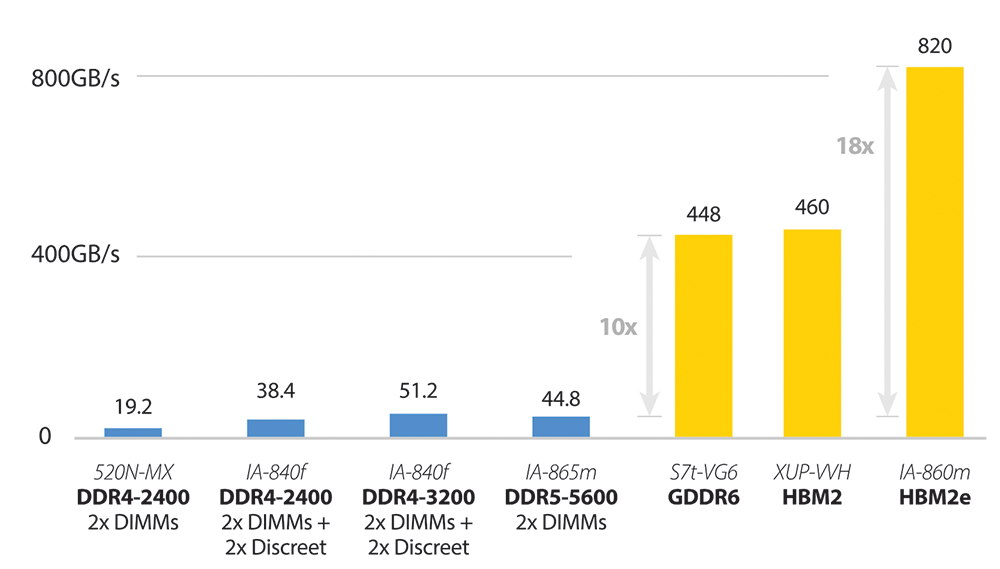 Figure 1. Comparison between DDR, GDDR and HBM (courtesy of bittware.com).
Figure 1 shows a significant increase in speed over DDR4, but this pales in comparison to the performance increases when looking at GDDR6 and HBM. Although not quite as fast as HBM2e, GDDR6 and HBM still outperform DDR5 by a 10x order of magnitude. GDDR6 supports two independent 16-bit channels per bank, so a card with eight banks of GDDR6 has up to 448 GB/s of available bandwidth.
| Tel: | +27 10 447 0180 |
| Email: | avnet-abacus-sales-southafrica@avnet.eu |
| www: | www.avnet.com/wps/portal/abacus |
| Articles: | More information and articles about Avnet Abacus |






© Technews Publishing (Pty) Ltd | All Rights Reserved
 printer friendly version