


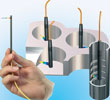
Sensors which can measure the distance to an object have many applications in the manufacturing industry.
The requirements on the measurement system may differ substantially depending on the application: the distance to be measured, the accuracy required and the type and surface of the object are just a few of the numerous factors that determine the choice of sensor. Sensors based on an optical measurement principle have the advantage that they are not subject to the negative effects of electromagnetic interference fields, nor to the effects of wear. In addition, optical measurement principles enable very high resolution, accuracy and repeatability.
The optoNCDT 2401 optical measurement system from Micro-Epsilon is based on an optical measuring principle, which specifically exploits the so-called chromatic aberration of light, which refers to the different refraction of light in relation to its wavelength.
Confocal measurement principle
The innovative optical sensor system consists of a controller and a sensor. It uses an LED whose light is passed from the controller, through an optical fibre, to the sensor. This optical fibre can be up to 50 m long, enabling the controller to be installed remotely from the sensor, providing an invaluable benefit in hazardous or explosive environments.
In the sensor, the polychromatic (white) light of the LED passes through an optical system of multiple lenses, which focuses the light onto the surface of the object to be measured. The lenses are arranged such that a specific chromatic aberration occurs – this means that light with a different wavelength or colour is focused to a different degree. The focus for blue light, for example, is located closer to the sensor than that for red light. The light reflected from the surface returns to the controller where it, in turn, passes through an optical system which images it onto a light-sensitive sensor element. The sensor element detects the spectrum of the reflected light and determines the distance to the measurement object by evaluating the colour. Through a calibration carried out by the manufacturer, each wavelength of light or colour is related to a certain distance to the measured object.
Technique offers advantages
A significant advantage of this technique is that the condition of the surface does not have any influence on the measurement accuracy. The system is even capable of precise measurements of reflective or transparent surfaces, which can quickly lead to errors with conventional measurement techniques. Depending on the sensor type, the measuring spot is only a few micrometres in size and also remains constant even with varying measurement distances. Consequently, very high resolution can be realised in all directions.
In the measurement direction, the minimum measurable change of distance is 3 nanometres. The sensor system is therefore ideally suited to three-dimensional topographical measurement of surfaces. In contrast to systems that operate with laser light, no precautions are required; since an LED is used as standard for the light source, the user does not need to consider laser protection class.
Application in capacitor production
During the production of capacitors, blanks must be precisely dipped into a bath of solvent. In order to guarantee quality features such as durability and short-circuit safety of the capacitors, it is necessary to dip the blanks as accurately as possible and according to the specification. For this purpose, the fill level of the solvent in the bath must be calculated precisely – to an accuracy of 50 μm. The reflective surface of the liquid and the solvent vapours present, as well as the wave motion on the liquid surface created when the capacitor blanks are dipped into the solvent, place additional demands on the measurement system.
Therefore, for this measurement, a confocal sensor with a measurement range of 24 mm is used, which is housed in a conduit using an O-ring. The solvent vapours, which could impair the measurement, are kept away from the optical system by using this construction. In addition, the conduit is heated, preventing the solvent vapours from condensing on the optical system. The controller, to which the sensor is connected via a 10 m long optical fibre, is located outside of the area subject to explosive hazards. With this measurement arrangement, it is possible to go far beyond the accuracy requirements for this application – overall, the measurement accuracy is 10 μm.
A flexible, versatile system
The measurement system described above is suitable for a diverse range of applications. With its very high resolution, it is suitable for the measurement of thickness, fill levels and surface topology. Apart from the example already mentioned, the system is being used for applications in electronics production, glass manufacture, in the process manufacturing industries and in R&D laboratories.
For more information contact Dieter Netter, Associated Technology, +27 (0)11 802 3320, [email protected], www.associated-technology.co.za
| Tel: | +27 11 802 7020 |
| Email: | [email protected] |
| www: | |
| Articles: | More information and articles about Associated Technology |






© Technews Publishing (Pty) Ltd | All Rights Reserved
 printer friendly version