

Manufacturing / Production Technology, Hardware & Services


X-ray inspection of lead-free solder joints

27 August 2003 Manufacturing / Production Technology, Hardware & Services

Microfocus X-ray inspection is a well established standard inspection method for hidden solder joints based on standard lead-tin alloys of area array packages such as BGA, CSP and Flip Chip. Due to increasing reliability requirements, it is also applied to the traditional THT and SMT solder joints, since it reveals internal voids and visualises optically obstructed solder meniscuses. Hitherto, the solder joints could be easily displayed at excellent contrast due to X-ray absorption of lead which is relatively high compared to that of PCB and component materials such as copper and epoxy.

The suitability of X-ray systems for the inspection of lead-free interconnections should be considered in light of the physical fundamentals of X-ray imaging. In microfocus X-ray systems the specimen is penetrated by a coneshaped X-ray beam which generates a magnified X-ray shadow image on the detector (presently an image intensifier, in most cases). The achievable resolution or image sharpness is mainly determined by the focal spot size of the X-ray tube which is typically in the range of a few microns but can amount to significantly less than 1 micron for novel nanofocus tubes. The magnification is given by the beam's geometry (Figure 1).
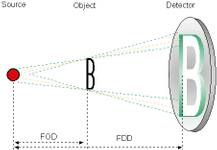
Figure 1. Operation principle of microfocus X-ray inspection: the geometric magnification is M= FDD/FOD. The resolution is determined by the size of the X-ray source which is mainly given by the focal spot size of the tube

Apart from magnification and contrast, the detectability of distinct object features depends on the contrast in the X-ray image caused by these features. Contrast is caused by different X-ray absorption of the different objects. Those differences in absorption can be due to variations in thickness or in material. As a rule of thumb for the image intensifier, we may assume that the absorption difference must amount to at least 2% to be clearly detected.

The physics of X-ray absorption

Physically, X-ray absorption is ruled by an exponential law:

Where I/IO is the ratio of the intensity of the X-ray beam before and after passing through the specimen. The material's influence is described by the mass absorption coefficient µ/ρ which also depends on the energy of the radiation quanta. [ρ] stands for the density of the material of thickness x. Furthermore, in the X-ray energy range of 30 to 160 keV which is normally used in microfocus X-ray inspection, the mass absorption coefficient µ/ρ strongly depends on the atomic number Z (approximately it increases proportionally with Z3). In Table 1, Z is listed for some materials which might be used in lead-free interconnections.
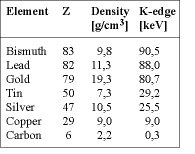
Table 1. Element data. Off the (K-) absorption edges, the mass absorption coefficient which rules the X-ray absorption is proportional to Z3

Lead-free solder joints

Presently, most lead-free solder alloys consist mainly of bismuth or - much more frequently - tin, as in eg, SnCuAg. For bismuth (Z=83) an X-ray absorption comparable to lead solders (PbSn) can be expected whereas for tin solders (Z=50), a much lower absorption and, hence, a remarkably poorer contrast might be feared. However, inspection practice shows that for example SnCuAg solder joints yield nearly the same contrast as PbSn solder joints (Figure 2).
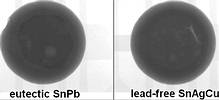
Figure 2. X-ray images of two BGA solder joints: eutectic lead-tin on the left and lead-free solder on the right. The images have been taken from assemblies with identical layout at exactly the same X-ray parameters, and have not been processed further. In the centre of the solder joints, the lands engulfed by the solder show as brighter circles

This can be understood immediately on the basis of the mass absorption coefficient (see Figure 3). The K-absorption edge of tin is located as low as 30 keV so that its mass absorption coefficient is even higher than that of lead or lead-tin alloys up to the K-absorption edge of lead at 88 keV. A numerical simulation (Figure 4) shows that tin solder joints can be expected to transmit a little more radiation within the image intensifier's most sensitive energy range (30 to 100 keV). And indeed, the lead-free solder joint in Figure 2 on the right appears slightly brighter than the PbSn solder joint on the left.
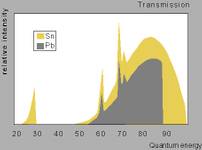
Figure 3. Mass absorption coefficient of lead, tin and bismuth as functions of         X-ray quantum energy. Due to the advantageous location of the K-absorption edges at 30 keV and 88 keV, the absorption of tin is similar to that of lead or tin-lead in the range of 30 to 80 keV
Figure 3. Mass absorption coefficient of lead, tin and bismuth as functions of X-ray quantum energy. Due to the advantageous location of the K-absorption edges at 30 keV and 88 keV, the absorption of tin is similar to that of lead or tin-lead in the range of 30 to 80 keV

Practical experiences

In inspection servicing, all test criteria for solder joint integrity and all signatures of the soldering process turned out to be clearly visible and valid for lead-free solder joints. Moreover, there are no restrictions concerning the automatic inspection and evaluation of lead-free BGA and CSP solder joints. This has been proven, in particular, during a screening within an investigation of void development in lead-free PBGA solder joints (Sn96Ag4 and Sn95,5Ag4Cu0,5). Mixed lots of lead-free and lead-tin solder joints could be inspected by the auto-setup BGA evaluation software without changing thresholds or X-ray parameters.
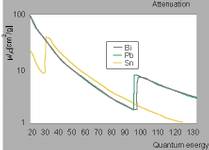
Figure 4. Transmission of the continuous X-ray spectrum (tungsten anode) at a typical tube voltage of 100 kV through 1 mm of tin (yellow) and lead (grey) – (numeric simulation)

Other lead-free interconnections

First X-ray inspections on adhesive interconnections in Flip Chips have been successfully performed. Here, stud-bumped Flip Chips were attached to the lands on a PCB by isotropic silver-filled glue. The interconnections could be securely inspected for mis-registration, adhesive distribution, short circuits etc. However, to evaluate those interconnections professionally, more experience and standardisation of criteria may still be necessary.

For interconnection media of very low contrast novel digital detectors have been developed which typically provide a contrast resolution four times better than that of the image intensifier.

The future of X-ray inspection

Dispelling widespread doubts, lead-free and, in particular, tin-based solder joints can be inspected without any problems provided that the X-ray system is of appropriate performance. Up to now, the appearance, at least, of the Sn based solder joints is quite similar to that of the PbSn solder joints and systematic deviations in thickness or shape have not yet been found.

To find X-ray inspection solutions for alternative interconnections such as adhesive bonding, the capabilities of X-ray inspection should be evaluated experimentally using the latest in X-ray equipment. Good results could be achieved for eg, with silver-filled adhesives.


Credit(s)


Share this article:
Share via emailShare via LinkedInPrint this page

Further reading:

World-first 016008 mm component placement
Manufacturing / Production Technology, Hardware & Services
Fuji has achieved the world’s first placement of 016008 mm (0,16 x 0,08 mm or 006 x 003 inches) size components on printed circuit boards with its SMT pick and place machine, NXTR.

Read more...
Lifecycle and obsolescence: Protecting electronics through process
Production Logix Manufacturing / Production Technology, Hardware & Services
At Production Logix, we believe longevity is not accidental. It is engineered through early visibility, structured response, and disciplined execution, in partnership with our OEM customers.

Read more...
Maximising squeegee quality and durability
Testerion Manufacturing / Production Technology, Hardware & Services
Transition Automation has announced two new product advancements designed to improve SMT printing performance and extend squeegee life: laser-enhanced Permalex bonding and integrated edge protectors.

Read more...
NeoDen ND2 PCB screen printer
ZETECH ONE Manufacturing / Production Technology, Hardware & Services
The NeoDen ND2 PCB screen printing machine is a fully automatic stencil printer designed to deliver precise and consistent solder paste application in modern SMT production environments.

Read more...
Understanding the BGA rework process
Techmet Manufacturing / Production Technology, Hardware & Services
BGA rework is a highly technical process that involves removing the faulty component, preparing the circuit board, and installing a new or repaired device, while maintaining the integrity of the printed circuit board.

Read more...
Flexible three-process reflow soldering system
Truth Electronic Manufacturing Manufacturing / Production Technology, Hardware & Services
By combining multiple soldering technologies within a single system, the Vision TripleX system enables manufacturers to adapt easily to different assembly requirements, board designs, and production volumes.

Read more...
Inline vapour phase soldering for high-volume production
MyKay Tronics Manufacturing / Production Technology, Hardware & Services
The VP2200-100 vacuum inline vapour phase soldering system from ASSCON is designed for fully automated, high-volume electronics manufacturing where process consistency and solder joint quality are critical.

Read more...
Global electronics solutions since 1964
IMP Electronics Solutions Manufacturing / Production Technology, Hardware & Services
Over more than six decades, IMP Electronics Solutions has built a reputation for technical expertise, reliable supply chains, and strong partnerships with both customers and manufacturing partners.

Read more...
Driving excellence in electronics manufacturing
Jemstech Editor's Choice Manufacturing / Production Technology, Hardware & Services
Jemstech’s reputation for disciplined execution and client-focused service has earned it strong loyalty from companies operating in demanding industries.

Read more...
When do you need Nitrogen in reflow?
Truth Electronic Manufacturing Manufacturing / Production Technology, Hardware & Services
Nitrogen in reflow soldering is often seen as a performance enhancer, offering improved wetting, shinier joints, and fewer defects. But it is not always necessary.

Read more...


While every effort has been made to ensure the accuracy of the information contained herein, the publisher and its agents cannot be held responsible for any errors contained, or any loss incurred as a result. Articles published do not necessarily reflect the views of the publishers. The editor reserves the right to alter or cut copy. Articles submitted are deemed to have been cleared for publication. Advertisements and company contact details are published as provided by the advertiser. Technews Publishing (Pty) Ltd cannot be held responsible for the accuracy or veracity of supplied material.


© Technews Publishing (Pty) Ltd | All Rights Reserved