


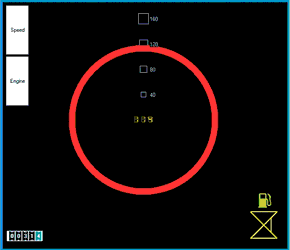
A South-African inventor has invented what he refers to as a ‘third-generation shape-based display technology’ where information is displayed as geometric shapes. This innovative concept, said to be a world first in display technology, is unique in that it does not require any reading.
The inventor, Sarel P. Wagner, says that in the last 560 years, virtually no improvements have been made on the basic display of information. The traditional concept of the steam gauge is still largely unchanged from the original invention. Mechanics may have given way to electronics, but the basic bargraph and steam gauge displays still require information to be read and interpreted.
The human brain is programmed for shape recognition. As a result, the new Geometrica shape-based technology is an ideal interface between man and machine. There is no longer any need to read or interpret information, making Geometrica-based displays fast and accurate. Just as we are able to recognise a face in a room full of others, our brain can instantly recognise a shape, and we only need to see it in peripheral vision. A person can remain focused on a primary task like driving, and at the same time perceive changes in a geometric figures shape, size and colour, without taking his or her eyes off the road.
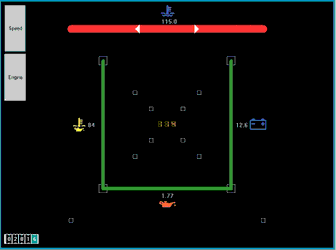
So how does this work?
Take a circular shape and have its radius represent speed. A small radius represents a low speed. As the speed increases, the radius expands and the circle gets bigger.
To represent multiple variables as a single status, take a triangle. The length of each leg represents a temperature or some other value. As the value increases the triangle leg extends in length. We now select the scale for each leg so that the desired nominal value, or range of values, results in a specific leg length. This value may be different for each leg. When all the values for the three legs are within the nominal range, the legs form an unbroken triangle and the sides (three legs) are coloured green. As soon as a value is out-side its nominal range, the corresponding leg changes length and colour.
It is now possible to convert data to status information using this technology and have a single point to monitor very complex systems, anything from factories to nuclear submarines. This technology has applications in the automotive, military, aircraft, industrial, medical, instrumentation and many other sectors.
A video showing a working device can be seen at www.microafrica.co.za/geometrica.avi and there is also a Word file explaining it at www.microafrica.co.za/geometrica.doc.
For more information contact Sarel P. Wagner, +27 (0)82 440 0191, sarel.wagner@gmail.com






© Technews Publishing (Pty) Ltd | All Rights Reserved
 printer friendly version