Lenslet Labs announces new optics-based DSP technology
27 February 2002
DSP, Micros & Memory
Lenslet Labs, an Israeli company, has unveiled the world's first commercial optics-based digital signal processing technology, following a successful technology demonstration.
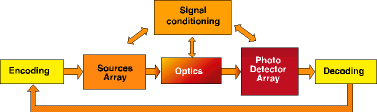
Lenslet’s optical digital signal processing engine converts electrical signals to optical signals (forward conversion)and the reverse (back conversion). Forward conversion (the sources array) can operate at a speed of 1 giga vectors per second while the ‘Back conversion (using photo detector array) can operate at even higher speeds
This technology boosts the performance of digital signal processing in a single component, setting new performance levels of Tera operations per second. The technology is based on a proprietary optical core that takes multiple electronic digital inputs, converts them into optical signals (photons), performs the desired computation at light speed in the optical core, and then converts the optical output signals back into digital electronic form. The company has taken advantage of new optical components that have appeared on the market in recent years, as well as breakthrough proprietary signal conditioning algorithms.
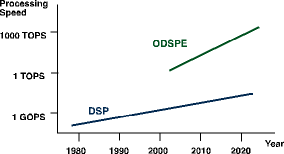
Lenslet's Optical Digital Signal Processing Engine (ODSPE) reaches Tera (1012) Operations Per Second (TOPS) and, according to the company, has the potential of reaching hundreds of TOPS in the foreseeable future, surpassing current DSP speeds that are measured in hundreds and thousands of Mega (106) Operations Per Second (MOPS).
The proprietory optical core achieves a performance equivalent to 8 Tera MAC operations per second, with a performance of hundreds of TOPs expected in the forseeable future
Unlike traditional DSPs, the ODSPE uses mathematical transforms rather than instructions as its basic atomic operations. This greatly accelerates software development time by mapping computation-intensive algorithms onto the ODSPE at a conceptually higher level of abstraction. Lenslet's ODSPE is re-configurable and can be dynamically tailored to the required transform type. Lenslet says it provides on-the-fly programmability, flexibility and upgradeability.
"Lenslet has been successful in leveraging optical technologies originally developed for optical transmission and switching, and applying them to optical computing using a unique algorithmic approach," said Aviram Sariel, Founder and CEO of Lenslet Labs.
"It is a very rare occasion when I can say that a company has a breakthrough technology, but Lenslet appears to have just that," said Will Strauss, President of Forward Concepts, a market research firm that specialises in DSP technology.
Lenslet Labs is headquartered in Ramat Gan, Israel, and employs over 40 professionals, most of them scientists and engineers with advanced degrees.
For further information contact Ron Levy, Lenslet Labs, (0972) 3 753 8410, [email protected]
Further reading:
Cost-effective microcontroller series
Altron Arrow
DSP, Micros & Memory
The STM32C5 series from STMicroelectronics delivers an excellent balance of performance, efficiency, and affordability for embedded designs that require more capability without increasing bill of materials cost.
Read more...
Battery-friendly Thread and BLE solution
iCorp Technologies
DSP, Micros & Memory
Positioned as an incremental upgrade to the ESP32-H2, Espressif’s ESP32-H21 adds an integrated DC-DC converter that reduces active current draw and helps extend battery life in power-sensitive consumer and industrial devices.
Read more...
Next generation HMI processing platform
Future Electronics
DSP, Micros & Memory
Microchip’s latest hybrid MCU SiP integrates an Arm926EJ-S processor with 512 Mb of DDR2 SDRAM and is engineered to meet the rising demand for sophisticated HMI solutions in modern vehicles.
Read more...
Low-power SoC for IoT designs
iCorp Technologies
DSP, Micros & Memory
Espressif’s ESP32-H4 is a dual-core 32-bit RISC-V SoC designed for battery-powered wireless products that require low energy consumption, strong security, and modern connectivity.
Read more...
Chip for high-density power
Future Electronics
DSP, Micros & Memory
Microchip’s dsPIC33AK256MPS306 Digital Signal Controllers combine high-resolution control, high-speed analogue, and security with support for post-quantum cryptography.
Read more...
The end of ‘entry-level’: STMicroelectronics’ STM32C5 sets a new baseline for embedded systems
DSP, Micros & Memory
[Sponsored] Instead of incrementally improving legacy Cortex-M0+ architectures, STM32C5 introduces a Cortex-M33-based platform into the entry-level category. This changes not only performance expectations, but also how engineers approach system architecture, consolidation, and long-term scalability.
Read more...
GigaDevice expands GD25UF Series density
NuVision Electronics
DSP, Micros & Memory
GigaDevice has announced the expanded density range of its GD25UF series 1,2 V ultra-low power SPI NOR Flash, now spanning from 8 Mb to 256 Mb.
Read more...
ARINC 429 line driver evaluation board
ASIC Design Services
DSP, Micros & Memory
Holt Integrated Circuits have announced the release of the ADK-85104 Evaluation Board, a compact, ready-to-use platform designed to help engineers rapidly evaluate and characterise Holt’s HI-85104.
Read more...
Highly integrated 24-channel mixed signal IC
EBV Electrolink
DSP, Micros & Memory
Microchip Technology has announced the LX4580, a 24-channel mixed-signal IC designed to replace multiple discrete components with a single device that supports synchronised data acquisition, fault monitoring, and motor control.
Read more...
Lower-power Thread and BLE connectivity
iCorp Technologies
DSP, Micros & Memory
Espressif has released the ESP32-H21, a low-power wireless SoC aimed at Thread, Matter, Zigbee, and Bluetooth LE device designs.
Read more...









 printer friendly version